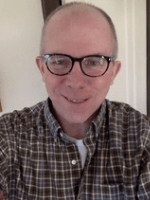
You find me today struggling with a question that has been plaguing me every day for the last thirty years. The question is deceptively simple: How is it possible that I am still alive? it’s a question that is based on cold and cruel scientific facts, and it’s a question that needs an answer. If you’re willing to join me, maybe this Chronicle can help me find that answer.
First, some background: On May 6th, 1996, I was diagnosed with brain cancer, the worst kind of brain cancer, which fittingly, has the ugliest name imaginable – Glioblastoma Multiforme (or GBM). The median survival rate for a patient with a GBM diagnosis was, and stubbornly remains, fifteen months. Two years is considered a long-term survival. There is no cure for this cancer. It’s a hopeless diagnosis. This diagnosis was all the more devastating as my wife and I were expecting our second child in just two weeks.
What’s going on here? The careful listener will recall that two years is considered an exceptional survival. I’m at thirty years. Three neurosurgeons have called me a miracle. Science can’t explain why I am still alive. So, I’ll accept miracle. Accepting the explanation of miracle is only something I can embrace because I believe that there is a responsibility of inspiring hope attached to the miracle. Hope is what I craved as soon as I could breathe again after hearing the hopeless diagnosis. The word responsibility may seem an odd choice, but it’s deeply anchored in survivor’s guilt.
I’m not comfortable with the term survivor’s guilt. because it seems to diminish the potency of the narrative of my survival, and more importantly to trivialize the deaths of all of those who were not blessed with my miraculous survival. I am not a hero and I did nothing heroic to reach thirty-years. I followed the standard medical protocol at the time, which is still the standard medical protocol, (surgical resection of the tumor, six-weeks of daily radiation and seven-months of chemotherapy). I’ve also had one hundred or more MRIs over the last thirty years to keep an eye on things. I thank God that every one of them has shown that my brain is healthy. I can only hope that I have thirty more years, or another one hundred clear MRIs ahead may receive, This is, I believe, my responsibility; I am here to tell a hopeful story. Sharing my story to change the GBM narrative.
I want to offer hope, NOT false hope. Genuine hope that permits at least one of the twelve thousand Americans diagnosed with a GBM every year to ask “Why not me?” instead of “Why me?”
Outro: Lean on Me, Bill Withers