

If the city of South Bend demolishes the fire-damaged Lafayette Building downtown, it would deal a blow to the city’s Black history. The potential demolition could increase the historical value of another building on the city’s west side.
The Lafayette Building downtown housed the offices of J. Chester and Elizabeth Allen. The married couple were not only two of South Bend’s first Black attorneys but they fought for civil rights, such as desegregating the city swimming pool, the Engman Natatorium.
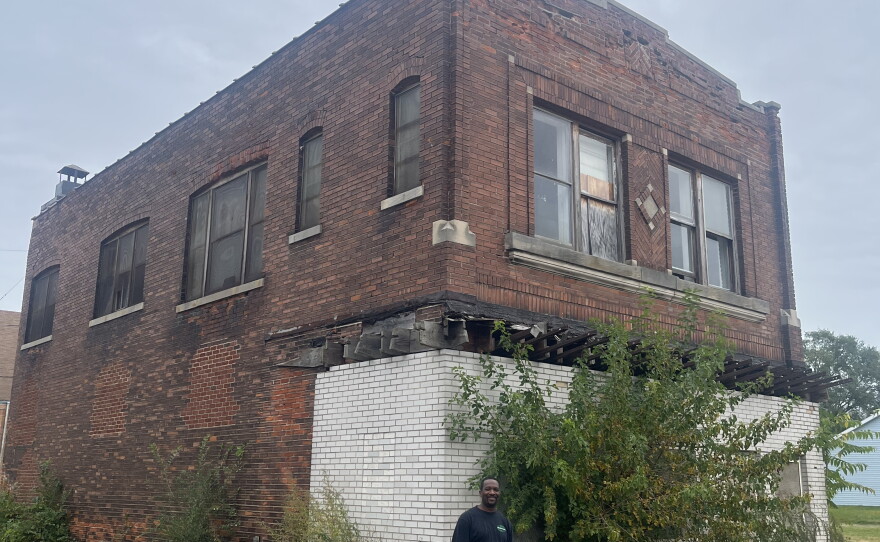
But before that, J. Chester had his first office in a much smaller two-story building, called the West Side Recreation Club, at 1415 W. Washington Street.
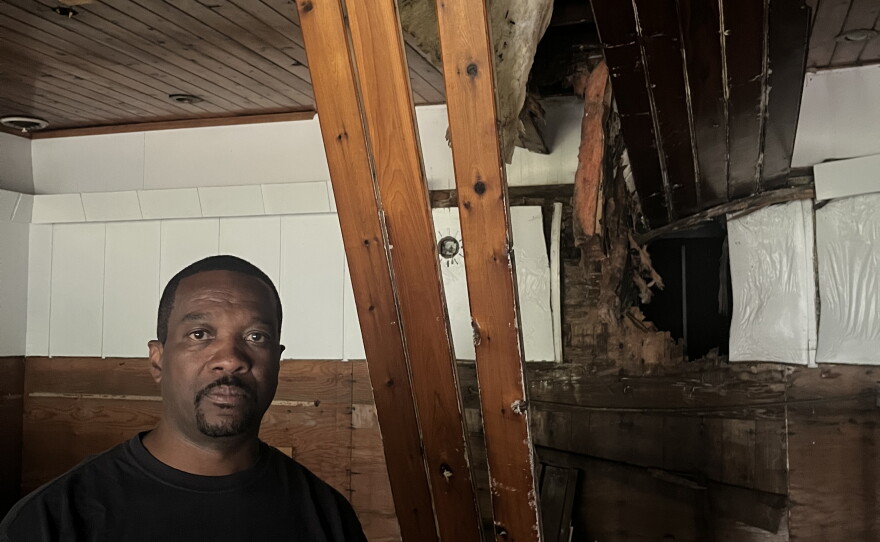
That building is now in bad shape. Its owner, Alfonso “Fonnie” Mack, recently showed me inside.
“We’ve got a little water damage back here in the back that needs to be repaired,” Mack says after we enter.
Mack is not a historic preservationist. He owns the Linden Grill restaurant downtown, and he lives a block away from the building.
He became interested in buying it five years ago. It had last served as the West Side Food Pantry but he noticed people were starting to throw parties there.
“It was a party going on in here," he recalls, "middle of the night, a bunch of gunshots going, some people was running through my back yard, through the alley, and when I came out, I seen a young lady over here, she had been shot in the leg or something, right on the side over here. So I was like, oh, this is a little too dangerous for the neighborhood. At the time, my son is 17 now, he might have been maybe 11 or 12, had a basketball rim out front, and there were bullet casings out in front of the basketball rim, him and his cousins play basketball.”
The building was owned by the New Testament Missionary Baptist church across the street. One day Mack was practicing chipping golf balls in a vacant lot when he saw someone from the church putting a “for sale” sign in the window.
“I walked over here and pretty much took the sign out of his hand," Mack says. "He said, what are you … I said take it down, I’m buying the building. Bought the building and then did a walk-through. It was a little more damaged than I thought but at the time it was for safety of the neighborhood and the community, it wasn’t about any history of the building.”
Since then people have been making Mack more aware of that history. IUSB’s Civil Rights Heritage Center has designated the building as one of 17 sites on its African American Landmark Tour. And last year the nonprofit historical preservation group Indiana Landmarks placed it on its annual 10 Most Endangered list.
Mack says recently part of the first floor ceiling fell in. He wants to somehow get the roof covered before winter hits.
“I need some help in getting this goal achieved because if not then we’re just going to lose it forever, but on the other hand, it’s like hey, you got to put it out there, let people know, there’s going to be some interest. So we do need some help. The first step is securing the roof.”
Todd Zeiger with Indiana Landmarks says time is running out.
“It’s rapidly deteriorating," Zeiger says, "and once it gets over the threshold of deterioration it will advance pretty quickly.”
Zeiger says Indiana Landmarks has grant money to help save historical buildings but to receive help they can’t be privately owned. But he says Indiana Landmarks is doing what it can. Last summer Zeiger had a historical preservation master’s student at Notre Dame do some conceptual drawings of how the building could look restored.
And Indiana Landmarks paid for a feasibility study out of its Black Heritage Preservation Fund that outlined the project needs and potential costs.
But Zeiger says volunteers serve on Indiana Landmarks’ Black Heritage Task Force in South Bend, and it will be up to them to help Mack incorporate as a nonprofit and transfer ownership of the building to the nonprofit.
But that won’t likely happen fast enough to get the roof covered by winter.
Retired librarian Cheryl Ashe is on the task force. She says it’s important to preserve the building.
“It was the first Black, African American lawyers, doctors, pharmacist, it was kind of the first a lot of things," Ashe says. "You know, we don’t realize that.”